WORGAV
Principalities and Powers · 23rd Century Intervention
Book 2: Starships and Encounters
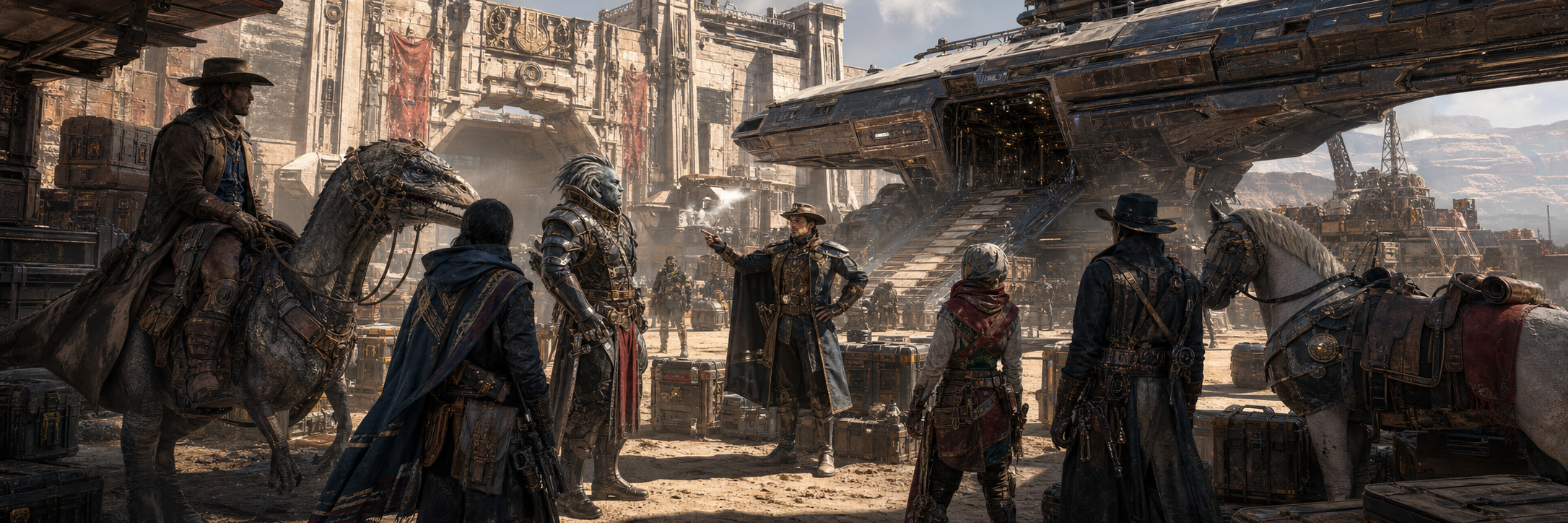
The universal encounter engine and the starship as a domain
Originally written by Jeffrey J. Kempton · Actualized 2026
PART I: THE UNIVERSAL ENCOUNTER ENGINE
Every encounter in Worgav — on the ground, underground, in vacuum, in a pressurized atmosphere, oversea, undersea, fortified, vehicular, ethereal, or astral — runs on one sequence. The sequence never changes; only three plug-in values do: the time slice (set by the medium and tempo, independent of command decisions), the hazard model (see the environment tables), and the content of the command nodes being resolved.
2.10.3 Free-Style Combat Round Algorithm
(For Human Game Masters and/or AI Moderators)
PHASE 0 — Initialization
Gather Input Data:
Update all known unit positions, motion vectors, status (health, morale, stealth, etc.).
Roll or generate NPD10 fate dice for each unit: Recon, Mortality, and Action.
Note all environmental signals (noise, light, radar/sonar pings, atmospheric changes).
Sort Units:
Order by physical scale or size (smallest → largest).
Within equal-size categories, order by lowest Recon roll (those with the lowest values act first).
PHASE 1 — Autonomous & Environmental Resolution
(Fog-of-war-exempt operations; GM or simulation authority step)
Advance Autonomous Entities:
Update all timed, traveling, or auto-guided entities (missiles, drones, ongoing spells, etc.) by (or the smallest time slice).
Detect collisions, impact points, and hazard zone intersections.
Apply Hazard Outcomes:
For each entity inside or entering a hazard, roll for Mortality/Damage.
Update resultant signals (explosions, fires, light bursts, auditory cues).
Resolve Autonomous Conflicts:
Remove destroyed objects.
Compute collateral and structural damage.
Apply causal chain effects (secondary blasts, falling debris, chain reactions).
PHASE 2 — NPC Resolution
Perform NPC Recon Rolls:
NPCs make simultaneous recon checks to detect events uncovered by Phase 1.
Resolve NPC Actions:
NPCs choose reactions, attacks, or movements based on their perception and updated situation.
Execute NPC-to-NPC interactions (combat, communications, coordination).
Remove NPC Casualties:
Update all status and remove incapacitated or destroyed entities from the active map.
PHASE 3 — Player Character Integration
Player Recon:
All player-controlled units make Recon rolls (possibly using both scouts or supporting systems).
The lowest Recon score acts first, with simultaneous execution allowed for equally low rolls.
At this point, players get their “heads-up” preview — a tactical snapshot right before action.
Player Actions:
Players declare and resolve moves, attacks, and abilities.
GM or AI integrates outcomes into the current battlefield state.
Feedback & Narrative Update:
The GM (or simulation controller) narratively describes combined outcomes:
Cause-and-effect chain of the round’s events.
Environmental and sensory feedback (critical for immersion and decision-making next round).
PHASE 4 — End-of-Round Update
Synchronize State:
Integrate all player/NPC/autonomous outcomes.
Advance environmental timers and ongoing effects (fires spread, alarms triggered, magic durations).
Display / Narrate Resultant State:
GM provides sensory-rich narration.
AI renders battlefield data with uncertainty zones (fog of war reinstated for players).
Commence Next Round:
Repeat from Phase 0.
Round duration is not fixed. It varies between mediums and by game tempo, and is independent of command decisions. The Tier-1 individual floor is 1 second; larger units and slower mediums advance the metronome in larger slices. (This supersedes any fixed 6-second round.)
PART II: THE STARSHIP AS A DOMAIN
A starship is not a separate subsystem — it is a domain whose seven hebdomad command nodes (7–13) are bridge stations. The same 43-node Codex and the same encounter engine apply unchanged. Only the node content and the time slice differ from ground play.
2.1 The Bridge Hebdomad
|
Node |
Ground role |
Starship station |
In combat |
|---|---|---|---|
|
7 |
Commander |
Pilot / Helm |
Steers the ship; commands the bridge |
|
8 |
Guard |
Communications |
Fleet coordination and signals |
|
9 |
Guard |
Sensors |
Detection, tracking, recon feed |
|
10 |
Quartermaster |
Chief Engineer |
Reactor, water/heat/lithium economy, damage control |
|
11 |
Guard |
Science |
Analysis, electronic warfare, specialist systems |
|
12 |
Guard |
Engineering support |
Power routing and repair under the Chief |
|
13 |
Navigator |
Astrogator |
Charts and jumps in transit; tactical/weapons officer in combat |
Node 10 (Chief Engineer) holds the shared water reserve every subsystem spends — cooling, thrust, screens, jump fuel, tritium breeding. Node 13 (Navigator) holds the charts and runs the jump risk roll in transit, then flips to firing solutions in combat. These two carry the heaviest system load in a fight.
2.2 Battle Metric at a Station
Node control follows the standard rule: Base Mode (Battle Metric) focus penalty = +15 − 5 × (number of focus nodes). One node +10, three nodes ±0, seven nodes −20. A Champion commanding more stations sharpens each action but is capped at seven.
PART III: PARTY FORMATION, MISSIONS & SUPPLY HUBS
8.1 The Call to Action
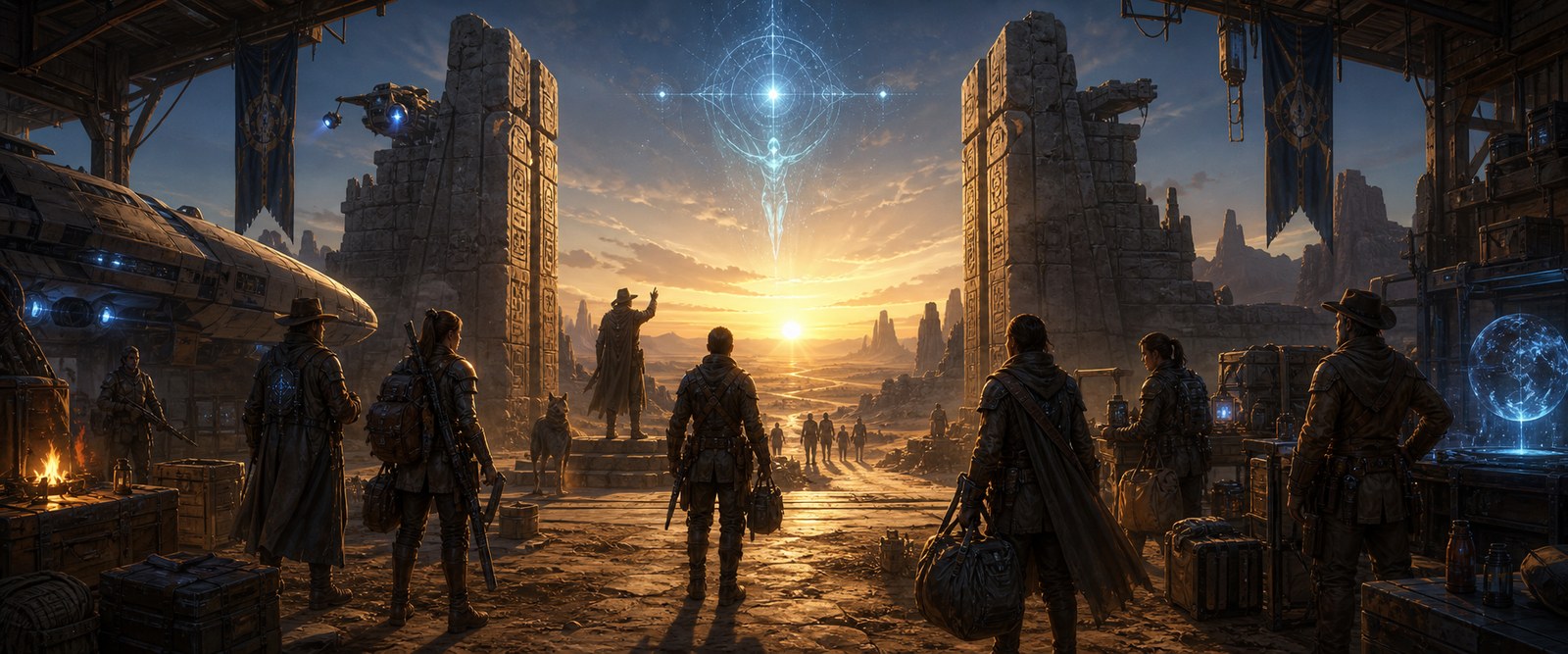
Every campaign begins the same way: awareness dawns, and the game world takes shape. You open your eyes and hear an echo in your mind — an old man quietly speaking: “So it was in the beginning, as it is now; the ways of humankind — never content, always expanding and fighting against each other.” You and up to seven other players, guided by a single Game Master, have been summoned to interact in a shared role-playing experience.
The maximum party size is eight participants: one Game Master and up to seven players. All parties operate within the same governing ruleset, and all domains are part of the same interconnected universe.
8.2 Party Formation
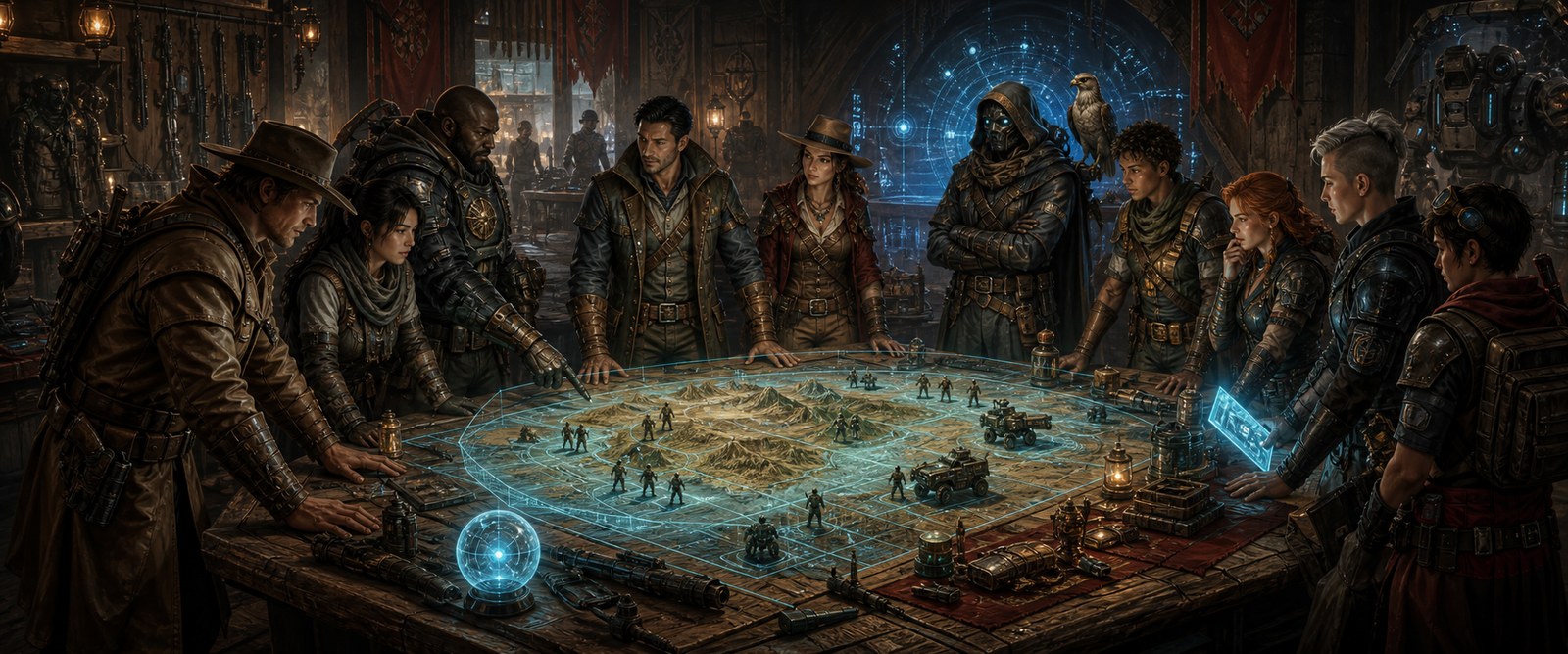
Before the first mission is assigned, the party must assemble. Party formation is not merely a logistical step — it sets the tone for the entire campaign. The process involves selecting characters, establishing roles, and reporting to your domain commander for orders.
Same Side or Simulation?
By default, all players are encouraged to operate on the same side and within the same domain. This promotes cooperation, streamlines logistics, and makes early missions significantly more survivable. For groups seeking a greater challenge, the computer simulation mode allows for opposing-force play, complex faction dynamics, and adversarial scenarios. Usually it is easier to play on the same side.
Character Creation
New players roll up characters before reporting for duty. Newly created characters begin as rookies, assigned to their first battle deployment under the supervision of the domain commander (see Part III for full character creation rules). Veterans rejoining after losses are integrated as reinforcements into ongoing campaigns.
|
GM Note — Party Size & Balance A full party of seven players is not required to begin play. Missions scale to available party size, but the GM should note that certain mission types — particularly Deep Space and multi-front Explorer campaigns — are designed for larger groups and carry significantly higher risk for undersized parties. |
|---|
8.3 Mission Types
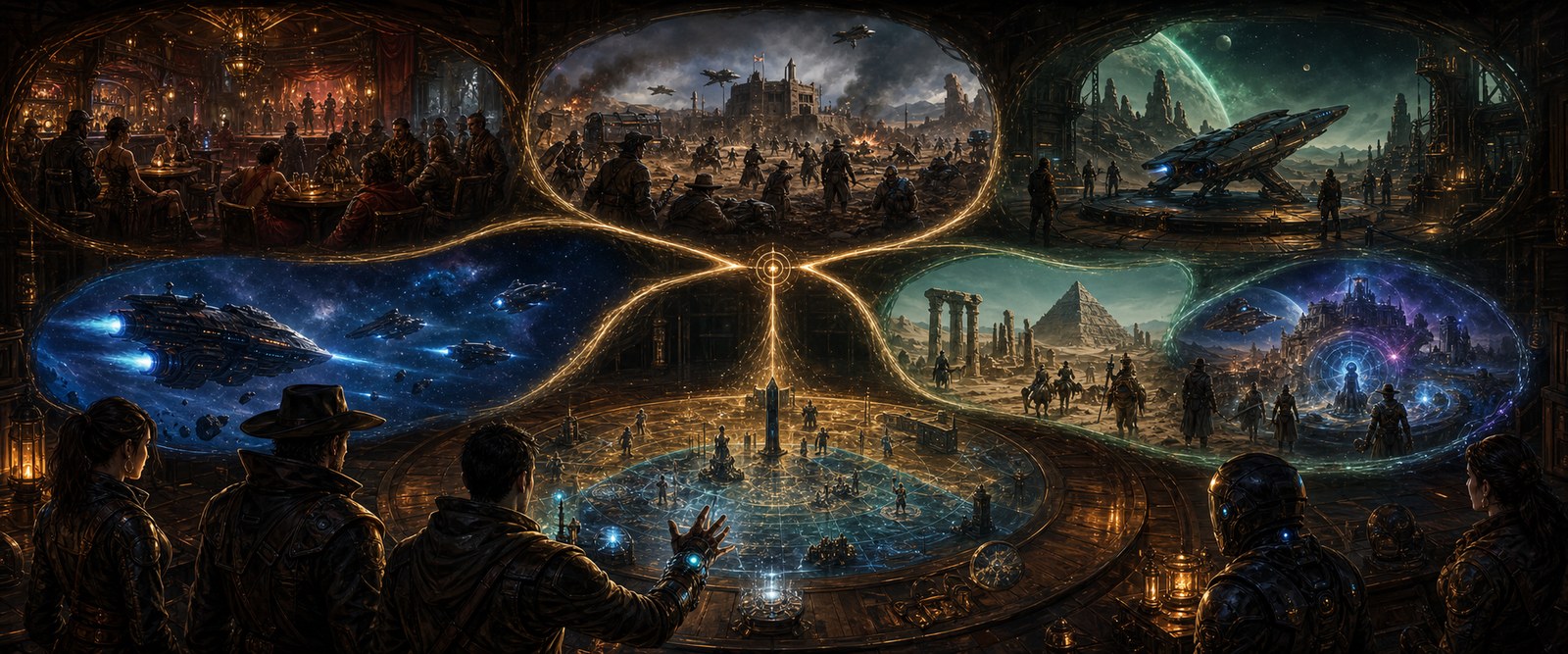
Once assembled, the party is assigned a scenario by the Game Master or domain commander. The following mission types are available at campaign start, each offering a distinct style of play, risk level, and reward structure.
|
Mission Type |
Description |
Party Requirement |
|---|---|---|
|
Social Downtime |
The party meets at the Mariner’s Club for drinks and entertainment. A low-stakes scenario ideal for character introductions, rumor gathering, and pre-mission planning. |
Any size party |
|
First Deployment |
New characters report to the domain commander for their inaugural battle deployment. A tutorial-style mission that establishes chain of command and basic combat rules. |
New characters only |
|
Explorer Campaign (New) |
The party launches a fresh Explorer campaign, charting unknown territory, making contact with new factions, and establishing a foothold beyond known space. |
3–7 players recommended |
|
Explorer Campaign (Continued) |
The party resumes a previous Explorer campaign after absorbing replacement personnel. Prior campaign notes and maps carry forward. |
Mixed veteran/rookie roster |
|
Deep Space Mission |
Assigned directly out of a Supply Hub, this long-range mission takes the party far from resupply lines. High risk, high reward — and high dependence on hub logistics. |
4–7 players; hub access required |
|
Combined / Custom Campaign |
A blend of the above scenarios, or a wholly new campaign designed by the Game Master. These missions are tailored to the party’s history and available resources. |
Game Master discretion |
Mission selection is not always in the party’s hands. Domain commanders may assign objectives based on strategic need, available intelligence, or resource availability at the nearest Supply Hub. Players should be prepared to adapt. Combinations of the above scenarios and entirely new campaigns are also possible.
8.4 Supply Hubs & Operating Base Command
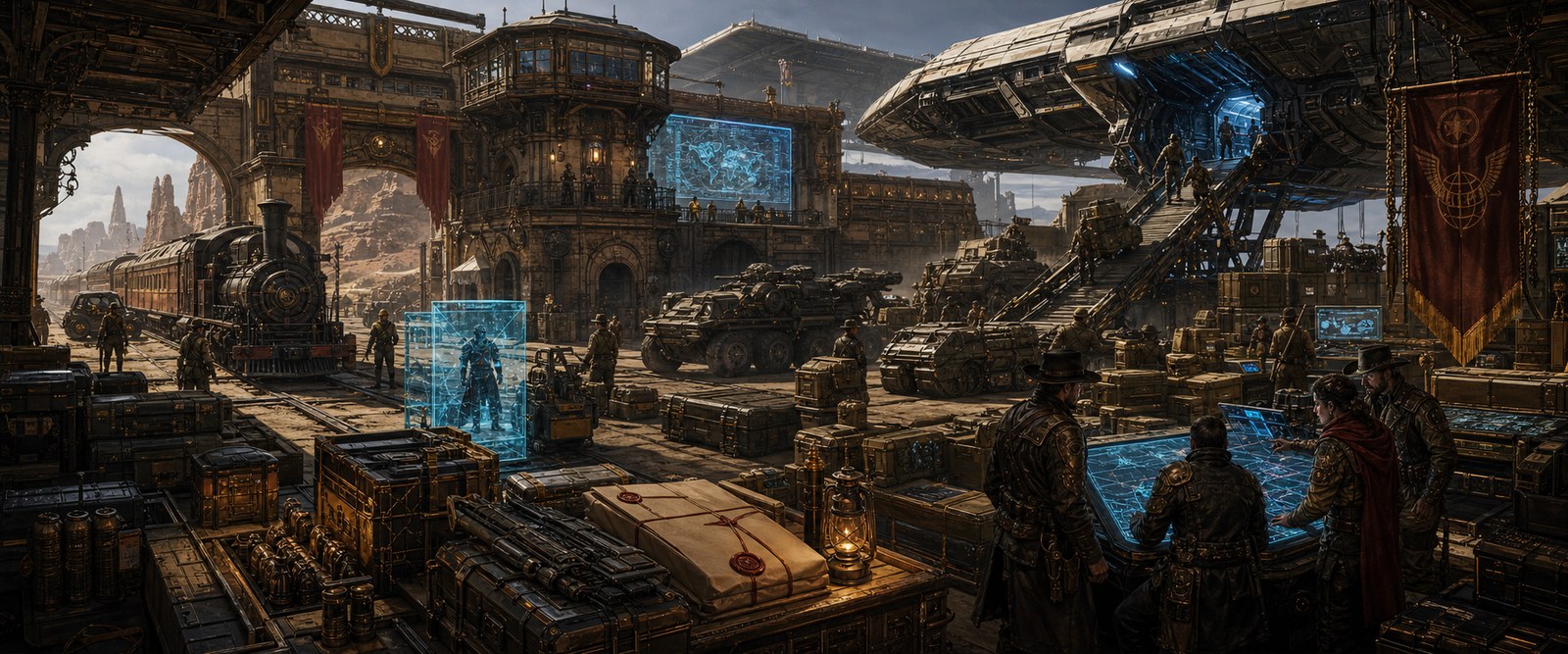
Supply Hubs are the lifeline of any extended campaign. Whether launching a Deep Space mission or resupplying between Explorer legs, all equipment, materiel, orders, and plans flow through Operating Base Command (OBC) and its network of Supply Hubs.
What a Supply Hub Provides
Every Supply Hub is capable of delivering the following to authorized parties:
Life support systems and consumables
Combat equipment, weapons, and field gear
Mission supplies and specialized materiel
Physical protection and security escort (where available)
General orders and updated mission briefings
Strategic plans and domain intelligence
Hub Access & Deep Space Assignments
Deep Space missions are assigned directly out of a Supply Hub. Before departure, the party must draw full supplies, confirm life support ratings, and receive sealed orders from the domain commander. Once a Deep Space mission is underway, resupply is not guaranteed — parties should plan for self-sufficiency across the full mission window.
|
Rule Reminder — Domain Interoperability All domains operate under the same rules. Regardless of which Supply Hub assigns your mission or which domain commander issues your orders, the same equipment standards, mission protocols, and chain-of-command structure apply across all domains. |
|---|
Operating Base Command
At the apex of the supply chain sits Operating Base Command (OBC). OBC is responsible for macro-level logistics: allocating supply across hubs, coordinating multi-domain operations, and issuing campaign-wide directives. Individual parties rarely interact with OBC directly, but its decisions shape the resources available at every hub in the network.
8.5 Playing in the Same Domain
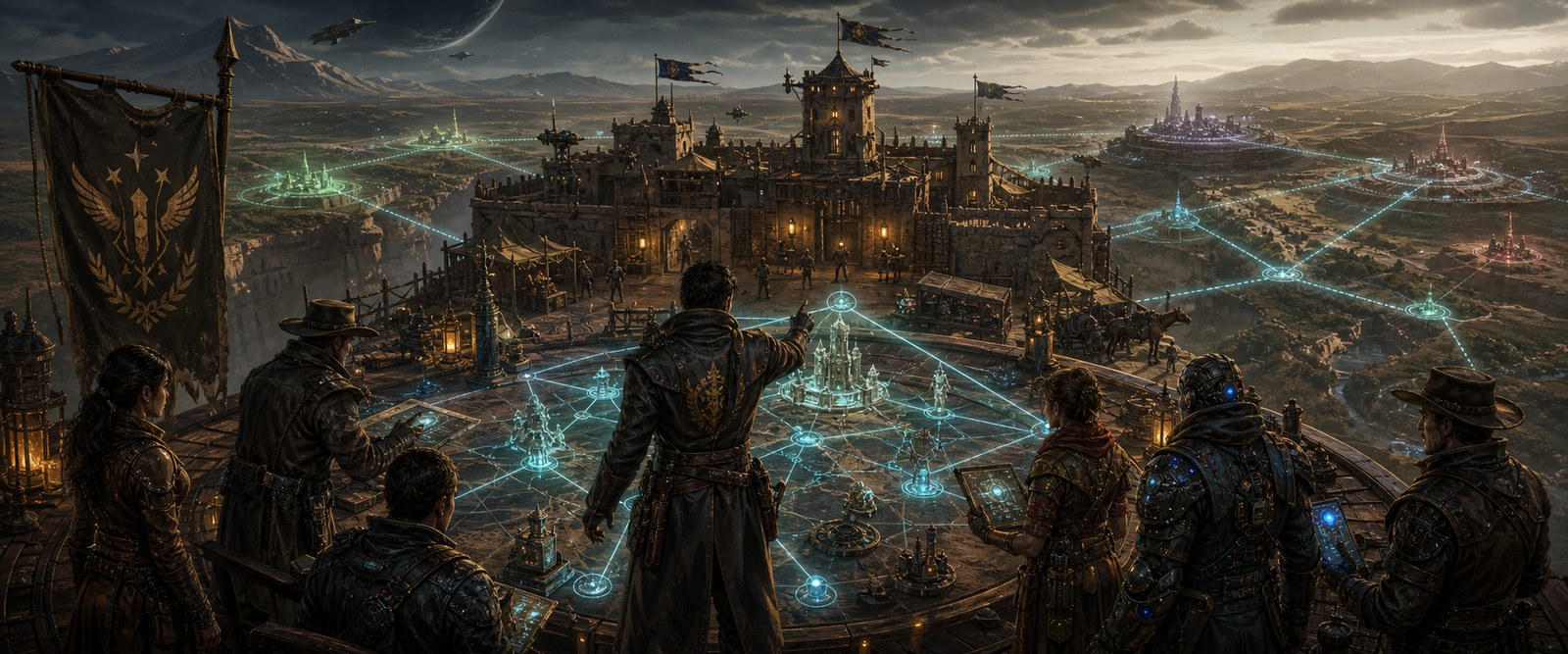
The simplest and most effective approach to party formation is to keep all players within a single domain. This ensures unified supply access, a shared chain of command, and consistent mission briefings. Cross-domain play is possible — particularly in combined campaign scenarios — but introduces additional complexity around supply routing, communication lag, and differing local orders.
For new parties or groups unfamiliar with the setting, same-domain play is strongly recommended until the group has completed at least one full campaign cycle.
PART IV: STARSHIP SYSTEMS (SUMMARY)
The full derivations of drive, power, thermal, hull, gravity-well, and jump physics live in Worgav Book 3: Universe and Game Theory. The encounter-relevant summary follows.
4.1 The Shared Water Economy
Water is 40% of hull mass and does seven jobs: coolant, thrust reactant, jump fuel, life-support oxygen, deuterium fuel source, neutron moderator, and radiation shield. In combat it is the master resource — every action the Chief Engineer allocates (cool, thrust, shield, jump, breed) spends the same reserve. A ship loses a fight by boiling dry, not by running out of ammunition.
4.2 Heat and the Combat Clock
Radiators shed steady cruise heat but are fragile and cannot retract under load. In combat, with radiators stowed, a ship runs on steam-dump cooling from its water reserve — minutes to over an hour of endurance depending on hull size and reserve. Large ships cannot sustain high-g burns at all (the thermal ceiling); they burst and drift.
4.3 Jumps in an Encounter
|
From → To |
1 pc hop |
2 pc hop |
|---|---|---|
|
charted → charted |
2.5% |
8.5% |
|
charted → uncharted |
20% |
68% |
|
uncharted → charted |
10% |
34% |
|
uncharted → uncharted |
80% |
97% |
Fuel is 5% of hull mass per parsec jumped. A jump deposits a heat pulse and imposes a recovery/cooling gate (~90 minutes for a frigate) before re-jumping — a ship caught in its recovery window cannot flee. Minimum jump mass is 100 t; sub-100 t craft are in-system only.
PART V: STARSHIP CONSTRUCTION
How hulls are built, what they cost, and how they are supplied. Construction physics (hull architecture, the A-36 pressure vessel, liftoff-once) is derived in Book 3, Part IV; this chapter is the builder- and quartermaster-facing procedure.
5.1 Building a Hull
Ships are constructed on land or in a cradle and repaired in pressurized space docks, with few exceptions. The mild carbon steel (A-36) pressure vessel is welded first as the airtight, field-repairable core; high-tech lightweight reinforcement and expansion joints are fitted over it; the dorsal I-beam spine and radiating ribs frame the plating. Large hulls fire the G-Drive to lift off the construction site exactly once and are void-only thereafter.
|
Class |
Hull mass |
Structure % |
Landing |
Built at |
|---|---|---|---|---|
|
Courier |
800 t |
13% |
4-leg, routine |
surface yard |
|
Frigate |
5,000 t |
12% |
4-leg, routine |
surface yard |
|
Destroyer |
20,000 t |
12% |
landing-capable |
surface / cradle |
|
Cruiser |
60,000 t |
9% |
liftoff-once |
cradle |
|
Capital |
200,000 t |
9% |
liftoff-once |
orbital cradle |
Two-tier industrial base: the A-36 shell can be welded and patched anywhere with ordinary gear; only advanced yards manufacture the high-tech reinforcement frames.
5.2 Construction Cost
Cost scales with hull mass, machinery (the reactor dominates), the jump-drive rating, and the fraction of high-tech reinforcement vs weldable steel.
⚑ PLACEHOLDER — define the currency (shared with Book 1 §8.3), a cost-per-tonne by hull class, the reactor/drive/jump-drive cost multipliers, and the surface-yard vs orbital-cradle cost differential. No cost data exists yet — establish base figures.
5.3 Logistics & Supply
A starship’s operational endurance is set by its consumables, not its energy. The shared water reserve (40% of hull mass) covers cooling, thrust, jump fuel, oxygen, and neutron shielding; lithium gates fast-burn combat and long jumps; deuterium is effectively unlimited from water.
|
Consumable |
Job |
Source |
Endurance driver |
|---|---|---|---|
|
Water (40% hull) |
cool/thrust/jump/O₂/shield |
ice moons, comets, gas-giant skim |
thermal & jump load |
|
Lithium-6 |
breeds tritium for fast-burn |
asteroid mining, starports |
~11 kg/day fast-burn (frigate) |
|
Deuterium |
fusion fuel |
156 ppm of all water |
effectively unlimited |
|
Tritium |
fast-burn fuel |
bred aboard only |
never stockpiled |
No-starport explorers are self-sufficient forever for cruise and jump on water alone; only sustained combat and long jumps are gated by mined, enriched lithium.
⚑ PLACEHOLDER — add resupply times and costs at supply hubs, the reblanketing procedure and cost for lithium, water-harvesting rates by source (comet vs gas-giant skim), and dock repair pricing. Cross-reference Part III supply-hub rules.
PART VI: WEAPONS & COMBAT
The universal engagement range is 10 km for all units except missiles and combat droids. About 99% of starships mount gravity guns ("blasters") on turrets, or on fixed wings for small fighters. Lasers are civilian equipment and combat-ineffective. Warships — roughly 5% of hulls — are the vessels described throughout this book.
6.1 The Gravity Gun
An inert-slug, recoilless weapon with a three-position fire selector. All modes draw from the same capacitor bank (~8 MW sustained on a ship mount), so the selector trades shot size against rate of fire — not total power. Rate is limited by capacitor recharge and barrel heat, not reactor output.
Ship-mounted blaster:
|
Mode |
Energy/shot |
Slug |
Muzzle vel. |
Rate |
Role |
|---|---|---|---|---|---|
|
1 — Heavy bolt |
50 MJ |
1 kg |
10 km/s |
1 per 6 s |
capital-ship breaker |
|
2 — Single shot |
8.3 MJ |
0.5 kg |
5.8 km/s |
1 per s |
workhorse gunnery |
|
3 — Semi-auto |
2 MJ |
0.25 kg |
4.1 km/s |
4 per s |
anti-fighter, point-defense |
Handheld blaster (battery pack):
|
Mode |
Energy |
Slug |
Muzzle vel. |
Rate |
|---|---|---|---|---|
|
1 — Heavy bolt |
20 kJ |
10 g |
2,000 m/s |
1 per 6 s |
|
2 — Single |
3.3 kJ |
5 g |
1,155 m/s |
1 per s |
|
3 — Semi-auto |
830 J |
2 g |
816 m/s |
4 per s |
A 2 MJ pack gives ~100 heavy bolts or ~2,400 semi-auto shots. Blasters are well weapons: at the galactic density floor, muzzle velocity falls ~3×. Recoilless at every setting.
Fighter-mounted blaster (fixed wing): the same weapon as the handheld — identical ballistic speeds and the same three-position selector — firing a heavier slug. It is a bullet, not a capital slug.
|
Mode |
Slug |
Muzzle vel. |
Energy |
Rate |
|---|---|---|---|---|
|
1 — Heavy bolt |
500 g |
2,000 m/s |
1 MJ |
1 per 6 s |
|
2 — Single |
250 g |
1,155 m/s |
167 kJ |
1 per s |
|
3 — Semi-auto |
100 g |
816 m/s |
33 kJ |
4 per s |
A fighter heavy bolt (1 MJ) hits ~50× lighter than a capital heavy bolt (50 MJ). Fighters kill fighters, small craft, and soft points (sensors, radiators, open bays); they harass capital ships but cannot defeat warship hull plate head-on — they rely on numbers, maneuver, and lucky hits. A capital ship's semi-auto mode (4 slugs/s) is its anti-fighter answer. Because their slugs are slow (2 km/s ≈ 5 s to cross 10 km), fighters fight close, inside the 10 km band; capital ships with 5–10 km/s slugs dominate the full range.
6.2 The Weapon–Counter Matrix
|
Threat |
Countered by |
Not countered by |
|---|---|---|
|
Lasers |
water fog, sand casters (soft-kill) |
armor alone (dwell burns through) |
|
Kinetics / blasters |
point-defense, evasion, armor |
fog or sand (mass beats ablation) |
|
Missiles |
point-defense, decoys, terminal fog |
standing still |
|
Gravity weapons |
range (flee the well), evasion |
fog or sand (not electromagnetic) |
No single screen stops everything, so a ship mixes defenses and spends water to run them. Fog and sand counter lasers; point-defense and evasion counter kinetics; range counters gravity weapons.
6.3 Gunnery at 10 km
Time-of-flight makes gunnery a lead-and-prediction duel. A 5 km/s ship slug crosses 10 km in 2 s, during which a target under 2 g maneuver shifts ~40 m; a slower slug gives a larger dodge window. Faster guns hit better, so ship blasters reliably engage at 10 km while handheld blasters are short-range. Solving the lead is the Navigator/tactical officer's combat task (bridge node 13).